Video
If the embedded player does not load in your browser, you can also watch the video directly on YouTube.
Abstract
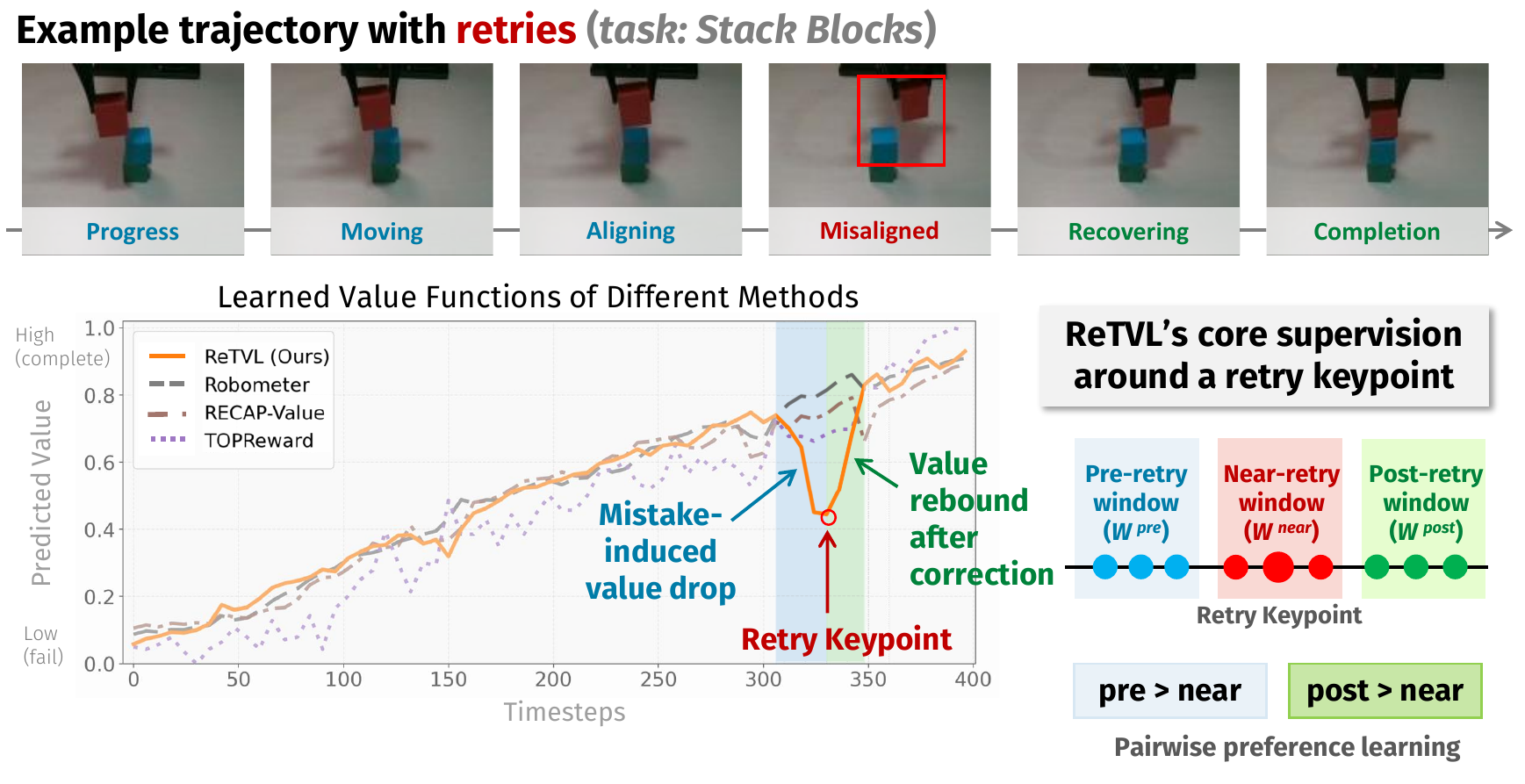
Human demonstrations for robot imitation learning often contain mistakes and corrective behaviors, such as imprecise grasps, object misalignment, unstable contact, and repeated attempts. While these segments are commonly treated as noisy or suboptimal data, they provide valuable evidence about when execution deviates from a desirable path and how task feasibility can be restored.
However, existing reward and value models often rely on monotonic progress assumptions, which capture coarse task advancement but may overlook local execution errors and corrective behaviors in imperfect demonstrations. We propose ReTVL (ReTry-Supervised Value Learning), a framework for learning mistake-sensitive value functions from mixed-quality robot demonstrations by leveraging retry events as sparse supervision.
ReTVL captures the local degradation-and-recovery structure around mistakes by combining global progress calibration with local pairwise preference learning induced by sparsely annotated retry keypoints. The learned value model is then used to reweight demonstration chunks for downstream behavior cloning, reducing the influence of harmful execution errors while preserving useful corrective behaviors. Experiments on real-robot manipulation tasks show that ReTVL produces more fine-grained value estimates than progress-based baselines and improves imitation learning from imperfect demonstrations.
Method
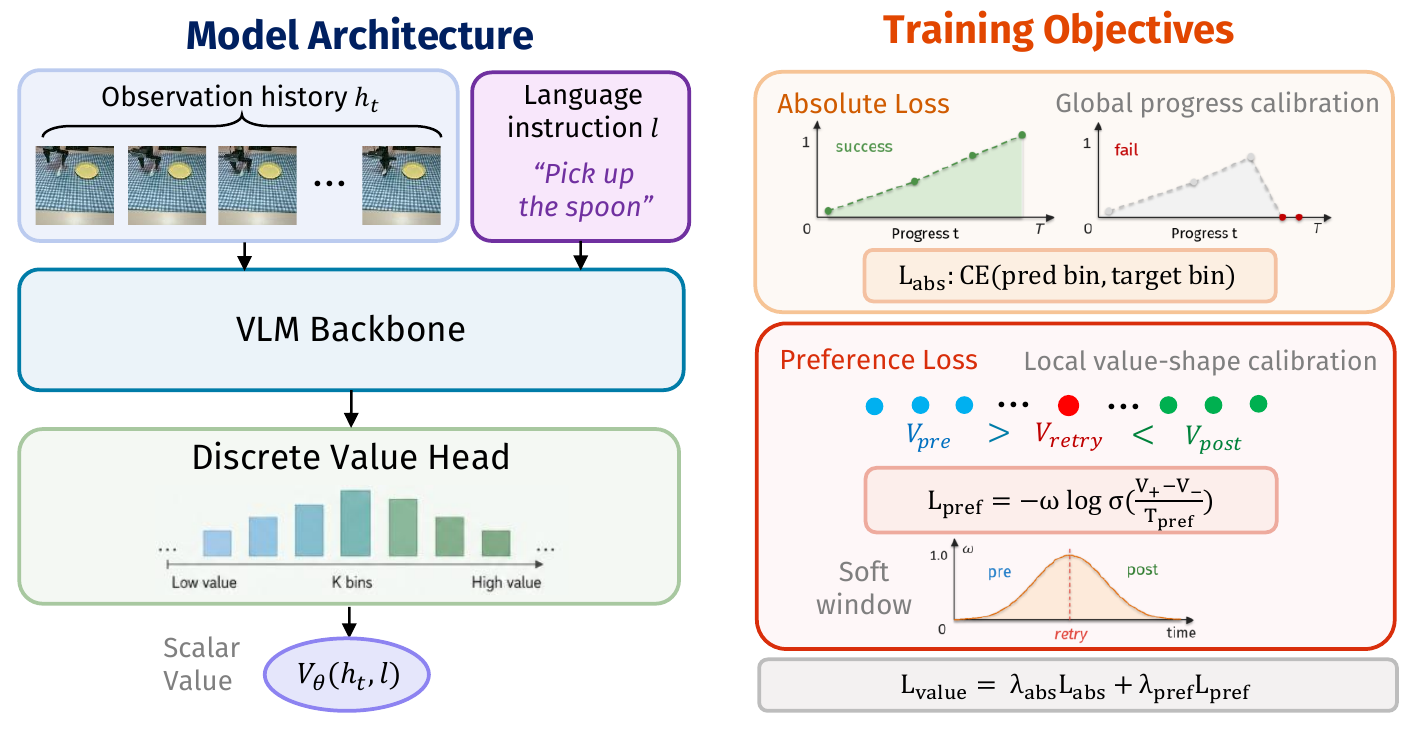
An absolute progress objective anchors the global value scale on successful and failed trajectories.
Sparse retry keypoints induce local pairwise orderings that capture mistake-related value drops and recovery.
The learned value signal reweights action chunks, suppressing harmful segments while retaining useful corrections.
Results
Value Estimation
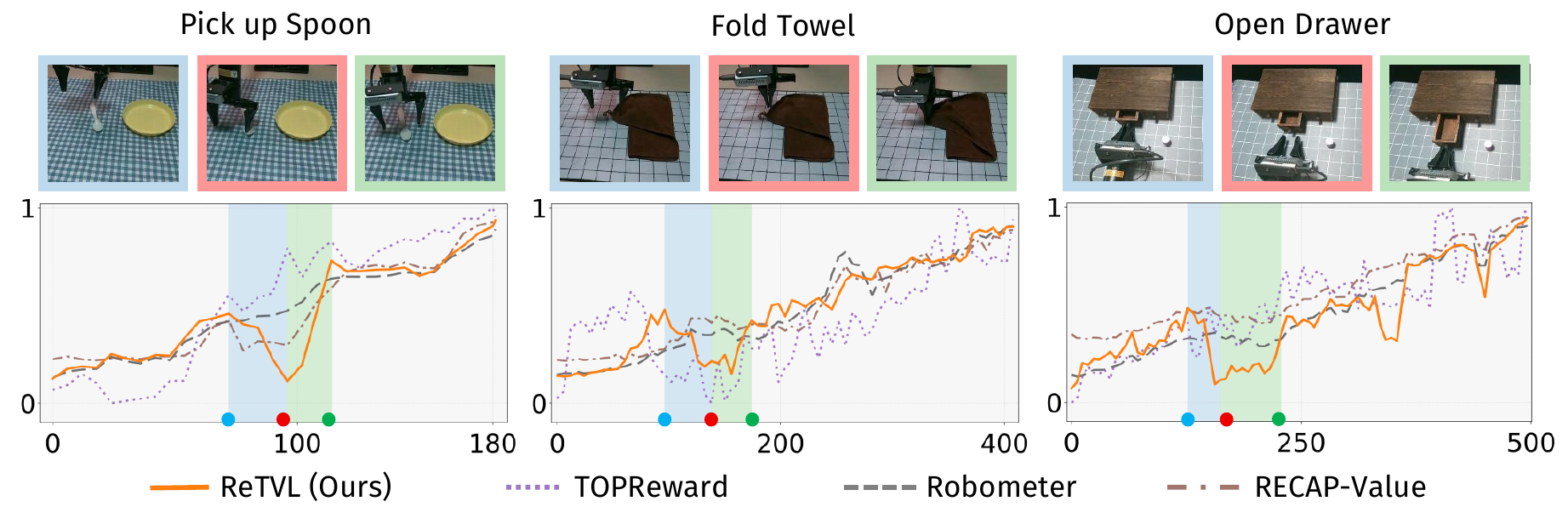
ReTVL captures localized value drops around retry events and rebounds after correction more clearly than progress-based baselines.
Representative held-out trajectories showing the evolution of predicted values around retry events.
Downstream Policy Learning
Average success rate across four real-robot tasks, with 20 evaluation trials per task.
Better filtering of harmful actions from mixed-quality demonstrations
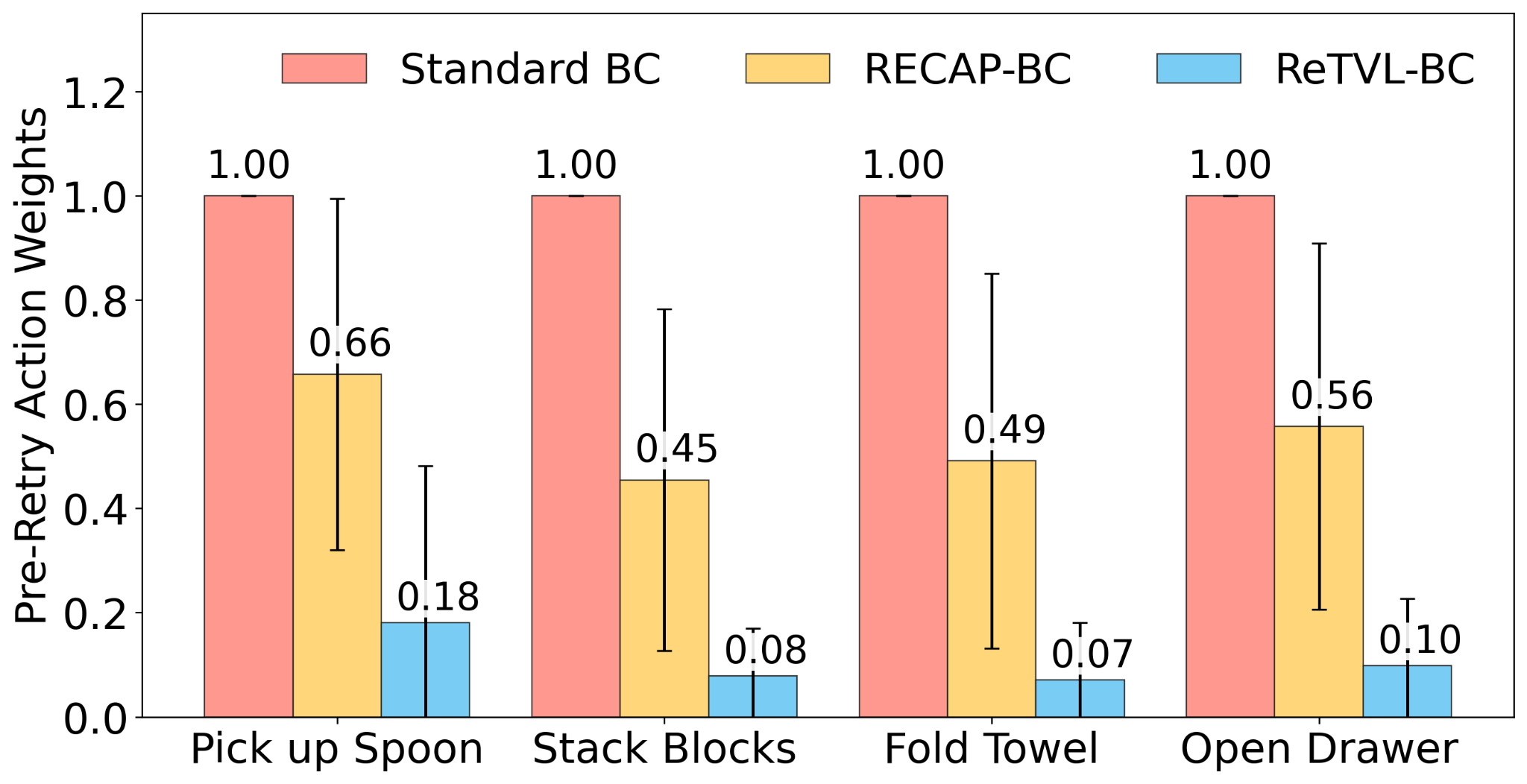
We use the trained value model to score action chunks in the mixed-quality policy-training dataset, and convert predicted value improvements into behavior-cloning weights.
Compared with progress-based weighting, ReTVL is more sensitive to local execution mistakes and assigns much lower weights to harmful pre-retry actions, while preserving useful corrective behavior.
Qualitative Policy Comparisons
Standard BC, RECAP-BC, and ReTVL-BC are shown from left to right.
Citation
@article{qin2026beyond,
  title={Beyond Monotonic Progress: Retry-Supervised Value Learning for Robot Imitation},
  author={Qin, Xinyao and Lu, Junjie and Wang, Kaixin and Zhang, Chuheng and Kang, Sinjae and Lee, Kimin and Xu, Min and Liang, Bin and Yang, Jun and Zhao, Li},
  journal={arXiv preprint arXiv:2606.24633},
  year={2026}
}